Share Cascadia High-Speed Rail and I-5 Program on FacebookShare Cascadia High-Speed Rail and I-5 Program on X (formerly Twitter)Share Cascadia High-Speed Rail and I-5 Program on LinkedinEmail Cascadia High-Speed Rail and I-5 Program link
Welcome to the Cascadia Program's public engagement site.
On this site, you can learn about the Cascadia Program's efforts to improve the way we travel today and in the future. This work includes projects that focus on making Interstate 5 (I-5) in Washington state safer and more reliable, while exploring how high-speed rail could transform regional connections and support our economy.
Take a quick survey to inform the future of this work. Your feedback will support planning and help us focus on what matters most to communities across the region when it comes to transportation.
The Cascadia Program draws its name from the megaregion this work supports. The megaregion includes the metropolitan areas of Vancouver, British Columbia; Seattle, Washington; and Portland, Oregon.
Why the Cascadia Program?
One program, two connected projects
The Washington State Department of Transportation's (WSDOT) Cascadia Program brings together two complementary planning projects to address current and future needs of our transportation system. These projects are the I-5 Master Plan and Cascadia High-Speed Rail.
The Cascadia megaregion is expected to grow by 3.4 million more people by 2050. This growth is equivalent to adding a city almost the size of Los Angeles to the megaregion. The increase in population will be matched by economic growth across industries like technology, aerospace, healthcare and logistics. Recent studies show that the strain on our existing transportation system will be significant by 2050.
In Washington, truck trips are expected to grow by 50-67% statewide by 2050. Currently, truck trips on I-5 make up to 20% of the total traffic.
Also in Washington, 80% of I-5 will operate at medium/high congestion by 2050, compared to 59% today.
In Oregon, 78% of I-5 in Portland will operate with severe congestion by 2045, compared to 33% in 2019.
Through the Cascadia Program, we are working to address our region's growing population and infrastructure demands to ensure the safe and reliable movement of people and goods. No single transportation option can meet all of Cascadia's future travel demands. Meeting the region's transportation needs will require every travel option to work together as a connected system; roads, rail, transit, walking, biking, air travel, ferries and freight all play important roles to prepare for our growing region.
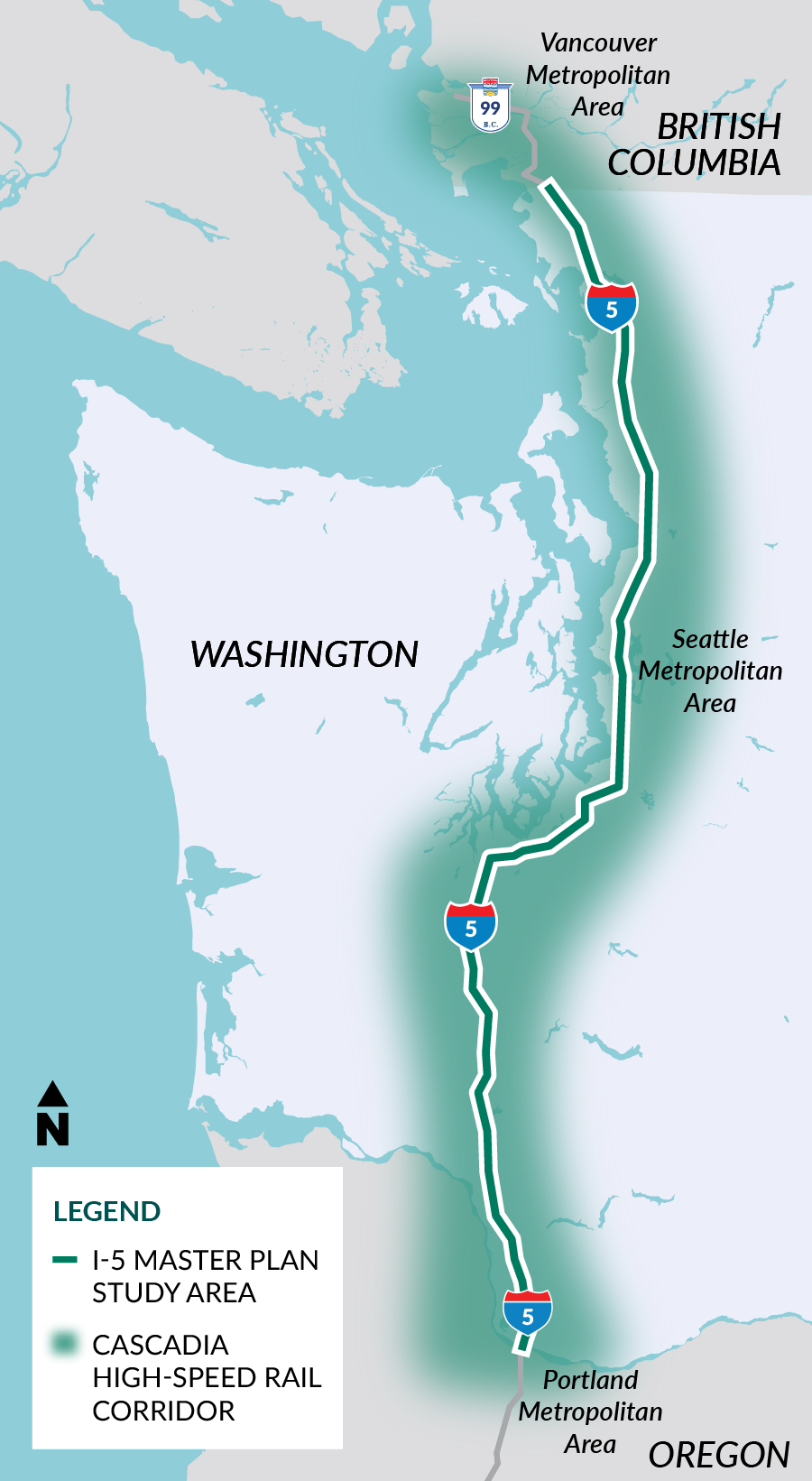
Map of corridor for Cascadia High-Speed Rail and the study area for the I-5 Master Plan.
Planning for tomorrow starts today
You are an important part of this planning effort. Transportation is more than getting from one place to another. It's about having the time, access, and reliable connections you need to reach your destinations safely.
Your input and participation are vital to the success of this program. We want to understand what matters to you as we identify and plan transportation projects that can improve our lives today and in the future.
Washington's I-5 is a critical transportation link that connects communities, businesses and major job centers from Canada to Oregon. This travel route runs 277 miles through Washington and passes through some of the state's fastest growing communities. As the megaregion grows, I-5 will need more improvements and additional funding to support the needs of our communities and economy.
To do this, WSDOT is developing the I-5 Master Plan. The plan will create a long-term roadmap for addressing current and future I-5 needs in Washington state.
I-5 is the north-south backbone of Washington's transportation system.
What is the I-5 Master Plan?
The Master Plan is not a single construction project. It is a broad plan to help direct transportation investments through 2050.
The Master Plan will:
Identify current and future transportation needs along I-5.
Explore potential strategies, programs, studies and projects to address those needs.
Consider how I-5 can better connect to transit, passenger rail, walking, biking and other transportation modes.
Identify opportunities to improve safety, reliability and resilience.
Help prioritize spending and identify future studies.
I-5 Master Plan overview
Scope
277 miles of I-5 in Washington.
Planning horizon: 2050.
What it does
Identifies programs, strategies, studies and projects.
Prioritized with funding pathways.
Why it matters
Improves safety, mobility, preservation, climate resiliency and system performance.
What we've learned
WSDOT is working to understand the corridor's greatest needs and opportunities by working with communities, Tribes, agencies, transportation partners and the public.
Through feedback heard during 91 listening sessions, WSDOT identified the following key priorities for I-5:
Congestion and travel reliability.
Aging infrastructure and maintenance.
Seismic and climate resilience.
Freight mobility.
Connections to other transportation modes.
Community connectivity and access.
Growing transportation demand.
Current work
WSDOT has completed a comprehensive review of regional transportation plans to develop six goal areas that support the prioritization of projects in the I-5 Master Plan:
System resiliency, preservation and environmental: Prepare for earthquakes, climate impacts and other disruptions. Maintain and modernize aging infrastructure.
Safety: Reduce serious and fatal crashes.
Mobility and accessibility: Make trips on I-5 more reliable and improve connections to transit, rail, walking, biking and communities.
Equity and community: Promote equitable access to the projects' transportation, economic and community benefits.
Economic vitality and movement of goods: Keep people and goods moving efficiently.
Innovation and future readiness: Prepare the corridor for future technologies and transportation needs.
How projects are prioritized
WSDOT will use data, technical analysis and community input to identify and prioritize strategies, programs, studies and projects. The prioritization process will follow the steps shown below:
1
Full List
Develop a broad list of projects and recommendations.
2
Screen
Identify projects and recommendations most relevant to the I-5 corridor.
3
Prioritize
Rank projects based on the Master Plan goals, corridor needs and interested parties’ input.
4
Recommendations
Prepare Master Plan recommendations.
Prioritization does not mean every project will be built immediately. The Master Plan will help establish a roadmap for future planning, funding, environmental review, design and implementation.
Once projects are prioritized based on their ability to fill a need in the I-5 system and meet the goal areas, they will be assessed against real-word factors like how ready they are to be built or if they complement another project already on the prioritized list.
Learn more about the I-5 Master Plan by visiting the project website.
What's next?
I-5 Master Plan development process
The plan moves through six steps from vision to implementation, publishing at the end of step 5. Steps 1 and 2 are complete. We are currently on step 3, identifying potential solutions.
1.Set Master Plan vision and goals
2.Identify additional I-5 needs
3.Identify potential solutionsWe are here
4.Prioritize solutions
5.Finalize recommendations
Milestone: publish the plan (2028)
6.Implement I-5 Master Plan and track progress
Education and engagement continues throughout every step.
Note: Completion and implementation of the I-5 Master Plan is dependent upon future funding.
The I-5 Master Plan is currently in development and is expected to be published in 2028. After publishing, WSDOT and its partners will begin implementing the Master Plan recommendations and tracking progress towards the Master Plan goals.
WSDOT, along with partners in British Columbia and Oregon, is studying if high-speed rail is a good transportation option for our region. High-speed rail is being studied because it offers fast and reliable travel between cities.
High-speed rail trains travel at speeds over 160 mph/260 kph and make fewer stops than regular passenger trains, such as Amtrak Cascades, which travel at a maximum speed of 79 mph/127 kph. Compared with driving or flying, high-speed rail could:
Shorten trips between major cities.
Give people another choice besides busy highways and airports.
Connect with buses, trains and other local travel options.
Move many people at one time.
Support jobs and businesses across the Cascadia megaregion.
High-speed rail offers fast, efficient connections between communities.
High-speed rail has proven to be safe, popular, fast and efficient around the world. The project team is comprised of experts who are working together to build on best practices and lessons learned from projects under development in the United States and Canada, as well as high-speed rail systems in use in other countries. High-speed rail service could significantly improve connectivity across the megaregion for personal and business travel.
Current project work will result in a service development plan that will look at where high-speed rail could go, how it could run and what benefits it could offer.
Would high-speed rail replace Amtrak Cascades?
No. Cascadia High-Speed Rail would complement the existing Amtrak Cascades passenger rail service. High-speed rail would make fewer stops and travel at greater speeds than conventional rail services, likely running on new, dedicated tracks. Think of high-speed rail as the express train, while Amtrak Cascades would be the local route.
What is the Cascadia High-Speed Rail Service Development Plan?
This is a plan that will assess the economic and technical feasibility of high-speed rail to reliably connect the metropolitan areas of Vancouver, British Columbia; Seattle, Washington; and Portland, Oregon.
The plan will identify potential routes and service options to explore in later stages, along with options for management and funding.
To do this, the plan will consider:
Population and employment growth.
Travel demand.
Existing transportation system capacity constraints.
Travel time and reliability.
Transportation choice and connectivity.
Economic development.
Geologic and environmental factors.
North Star guiding principles
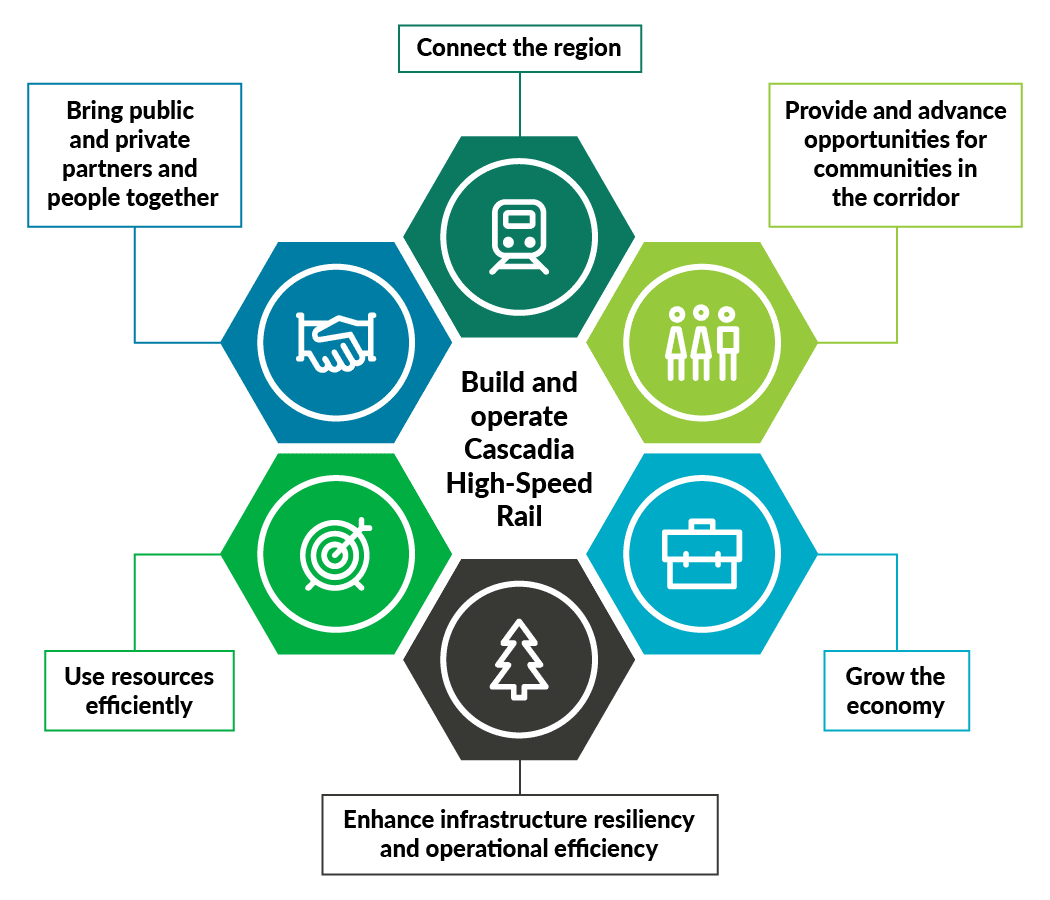
High-Speed Rail North Star guiding principles.
Planning for high-speed rail is directed by six guiding principles:
Connect the region.
Provide and advance opportunities for communities in the corridor.
Grow the economy.
Enhance infrastructure resilience and operational efficiency.
Use resources efficiently.
Bring public and private partners and people together.
What we've learned
As the Cascadia megaregion continues to grow, understanding future transportation needs is an important part of planning for the region's long-term mobility. Past studies found that high-speed rail could support jobs and improve travel. It could also connect communities to major job centers and move some trips away from other travel options that have limited growth potential.
The 2025 Cascadia High-Speed Rail Market Analysis found future demand for additional transportation capacity in the Cascadia megaregion and supported continued study of high-speed rail.
The analysis also looked at how people travel today and where they may travel in the future. This helped point to where high-speed rail could add more capacity to our existing transportation system if this service were added as an additional travel option.
Current work
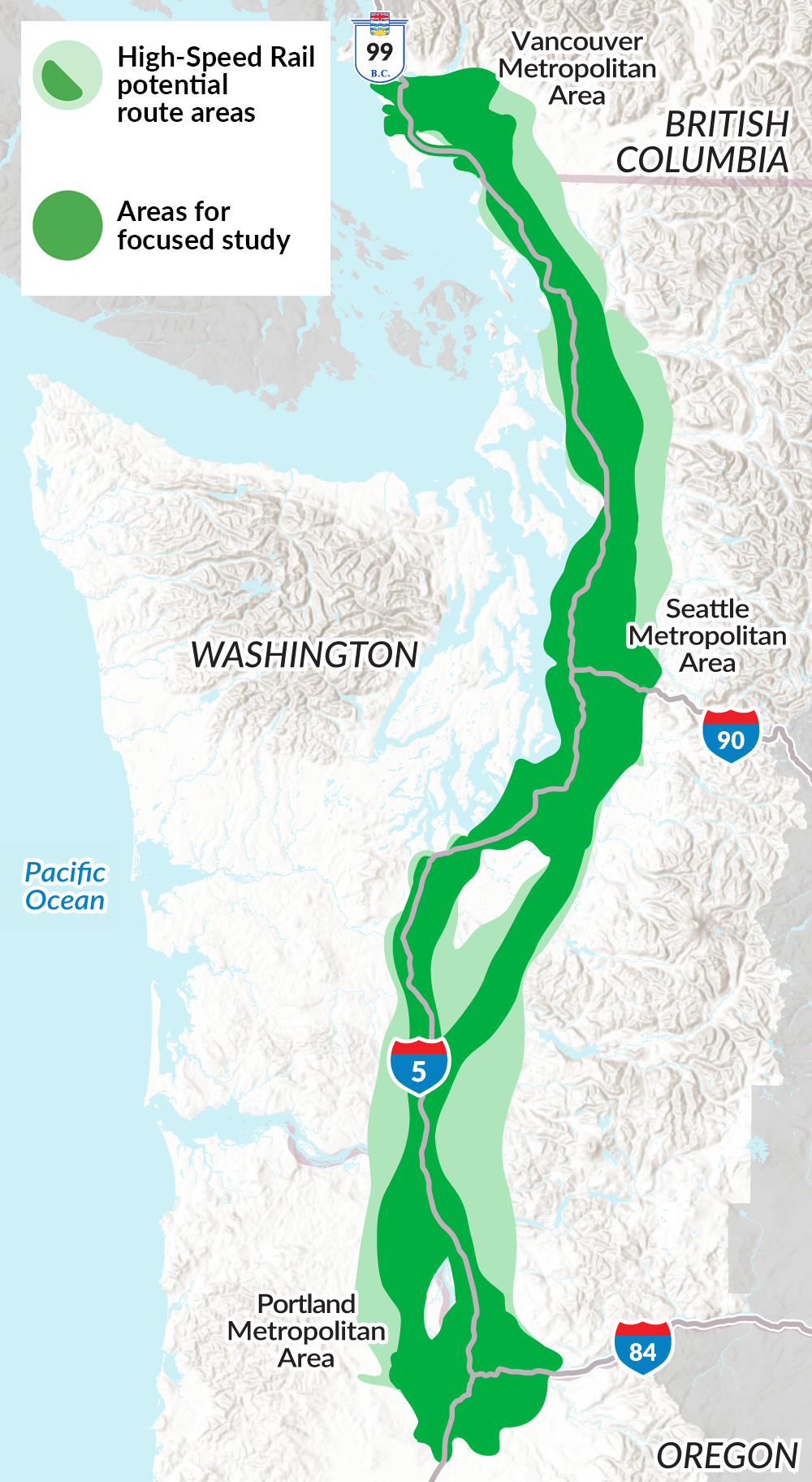
In 2025, the project advanced early analysis to refine the potential area where high-speed rail could go in the future. The Phase 2 map below shows the broad area where a potential route could go.
Phase 1
Q2-Q4 2025
High-Speed Rail Corridor
Phase 2
Q1-Q3 2026
Refined High-Speed Rail Corridor
Phase 1 and Phase 2 of the high-speed rail corridor analysis.
Over the next two years the project will advance early planning work to explore the following:
Potential route areas where high-speed rail might run.
Potential ridership analysis and modeling.
Conceptual service options; including frequency of trips, train speeds and number of stops.
Engineering and operational considerations.
Environmental opportunities and challenges.
Potential connections to existing transportation systems.
At this stage, the project is not selecting a preferred route or specific station locations. The goal is to identify a range of potential options for further study.
To learn more about the Cascadia High-Speed Rail Service Development Plan, visit the project website.
What's next
Cascadia High-Speed Rail project development process
Service Development PlanWe are here
Environmental / Planning
Design
Construction
Start of service
Education and engagement continues throughout every step.
Note: Canadian project elements will follow the appropriate federal and provincial environmental assessment processes.
The Cascadia High-Speed Rail Service Development Plan is expected to be completed in 2028. Over the next several years, WSDOT and its partners will continue building on the planning work completed to date. The Service Development Plan is the first step of the planning process, with formal environmental review, design and construction still to come.
Project planning analyses, studies, and work products developed with agency, Tribal Nations and public engagement as a part of the Corridor Identification and Development Program may be incorporated into future project development and environmental review processes, as applicable. (23 CFR 771.111)
Help shape the future of transportation for decades to come
By responding to this survey, you will help WSDOT understand your transportation priorities and needs related to these projects. Your feedback will inform recommendations, drive future planning and help us focus on what matters most to communities when it comes to our transportation system. There are no right or wrong answers. The survey is estimated to take around 8–10 minutes to complete.
Welcome to the Cascadia Program's public engagement site.
On this site, you can learn about the Cascadia Program's efforts to improve the way we travel today and in the future. This work includes projects that focus on making Interstate 5 (I-5) in Washington state safer and more reliable, while exploring how high-speed rail could transform regional connections and support our economy.
Take a quick survey to inform the future of this work. Your feedback will support planning and help us focus on what matters most to communities across the region when it comes to transportation.
The Cascadia Program draws its name from the megaregion this work supports. The megaregion includes the metropolitan areas of Vancouver, British Columbia; Seattle, Washington; and Portland, Oregon.
Why the Cascadia Program?
One program, two connected projects
The Washington State Department of Transportation's (WSDOT) Cascadia Program brings together two complementary planning projects to address current and future needs of our transportation system. These projects are the I-5 Master Plan and Cascadia High-Speed Rail.
The Cascadia megaregion is expected to grow by 3.4 million more people by 2050. This growth is equivalent to adding a city almost the size of Los Angeles to the megaregion. The increase in population will be matched by economic growth across industries like technology, aerospace, healthcare and logistics. Recent studies show that the strain on our existing transportation system will be significant by 2050.
In Washington, truck trips are expected to grow by 50-67% statewide by 2050. Currently, truck trips on I-5 make up to 20% of the total traffic.
Also in Washington, 80% of I-5 will operate at medium/high congestion by 2050, compared to 59% today.
In Oregon, 78% of I-5 in Portland will operate with severe congestion by 2045, compared to 33% in 2019.
Through the Cascadia Program, we are working to address our region's growing population and infrastructure demands to ensure the safe and reliable movement of people and goods. No single transportation option can meet all of Cascadia's future travel demands. Meeting the region's transportation needs will require every travel option to work together as a connected system; roads, rail, transit, walking, biking, air travel, ferries and freight all play important roles to prepare for our growing region.
Map of corridor for Cascadia High-Speed Rail and the study area for the I-5 Master Plan.
Planning for tomorrow starts today
You are an important part of this planning effort. Transportation is more than getting from one place to another. It's about having the time, access, and reliable connections you need to reach your destinations safely.
Your input and participation are vital to the success of this program. We want to understand what matters to you as we identify and plan transportation projects that can improve our lives today and in the future.
Washington's I-5 is a critical transportation link that connects communities, businesses and major job centers from Canada to Oregon. This travel route runs 277 miles through Washington and passes through some of the state's fastest growing communities. As the megaregion grows, I-5 will need more improvements and additional funding to support the needs of our communities and economy.
To do this, WSDOT is developing the I-5 Master Plan. The plan will create a long-term roadmap for addressing current and future I-5 needs in Washington state.
I-5 is the north-south backbone of Washington's transportation system.
What is the I-5 Master Plan?
The Master Plan is not a single construction project. It is a broad plan to help direct transportation investments through 2050.
The Master Plan will:
Identify current and future transportation needs along I-5.
Explore potential strategies, programs, studies and projects to address those needs.
Consider how I-5 can better connect to transit, passenger rail, walking, biking and other transportation modes.
Identify opportunities to improve safety, reliability and resilience.
Help prioritize spending and identify future studies.
I-5 Master Plan overview
Scope
277 miles of I-5 in Washington.
Planning horizon: 2050.
What it does
Identifies programs, strategies, studies and projects.
Prioritized with funding pathways.
Why it matters
Improves safety, mobility, preservation, climate resiliency and system performance.
What we've learned
WSDOT is working to understand the corridor's greatest needs and opportunities by working with communities, Tribes, agencies, transportation partners and the public.
Through feedback heard during 91 listening sessions, WSDOT identified the following key priorities for I-5:
Congestion and travel reliability.
Aging infrastructure and maintenance.
Seismic and climate resilience.
Freight mobility.
Connections to other transportation modes.
Community connectivity and access.
Growing transportation demand.
Current work
WSDOT has completed a comprehensive review of regional transportation plans to develop six goal areas that support the prioritization of projects in the I-5 Master Plan:
System resiliency, preservation and environmental: Prepare for earthquakes, climate impacts and other disruptions. Maintain and modernize aging infrastructure.
Safety: Reduce serious and fatal crashes.
Mobility and accessibility: Make trips on I-5 more reliable and improve connections to transit, rail, walking, biking and communities.
Equity and community: Promote equitable access to the projects' transportation, economic and community benefits.
Economic vitality and movement of goods: Keep people and goods moving efficiently.
Innovation and future readiness: Prepare the corridor for future technologies and transportation needs.
How projects are prioritized
WSDOT will use data, technical analysis and community input to identify and prioritize strategies, programs, studies and projects. The prioritization process will follow the steps shown below:
1
Full List
Develop a broad list of projects and recommendations.
2
Screen
Identify projects and recommendations most relevant to the I-5 corridor.
3
Prioritize
Rank projects based on the Master Plan goals, corridor needs and interested parties’ input.
4
Recommendations
Prepare Master Plan recommendations.
Prioritization does not mean every project will be built immediately. The Master Plan will help establish a roadmap for future planning, funding, environmental review, design and implementation.
Once projects are prioritized based on their ability to fill a need in the I-5 system and meet the goal areas, they will be assessed against real-word factors like how ready they are to be built or if they complement another project already on the prioritized list.
Learn more about the I-5 Master Plan by visiting the project website.
What's next?
I-5 Master Plan development process
The plan moves through six steps from vision to implementation, publishing at the end of step 5. Steps 1 and 2 are complete. We are currently on step 3, identifying potential solutions.
1.Set Master Plan vision and goals
2.Identify additional I-5 needs
3.Identify potential solutionsWe are here
4.Prioritize solutions
5.Finalize recommendations
Milestone: publish the plan (2028)
6.Implement I-5 Master Plan and track progress
Education and engagement continues throughout every step.
Note: Completion and implementation of the I-5 Master Plan is dependent upon future funding.
The I-5 Master Plan is currently in development and is expected to be published in 2028. After publishing, WSDOT and its partners will begin implementing the Master Plan recommendations and tracking progress towards the Master Plan goals.
WSDOT, along with partners in British Columbia and Oregon, is studying if high-speed rail is a good transportation option for our region. High-speed rail is being studied because it offers fast and reliable travel between cities.
High-speed rail trains travel at speeds over 160 mph/260 kph and make fewer stops than regular passenger trains, such as Amtrak Cascades, which travel at a maximum speed of 79 mph/127 kph. Compared with driving or flying, high-speed rail could:
Shorten trips between major cities.
Give people another choice besides busy highways and airports.
Connect with buses, trains and other local travel options.
Move many people at one time.
Support jobs and businesses across the Cascadia megaregion.
High-speed rail offers fast, efficient connections between communities.
High-speed rail has proven to be safe, popular, fast and efficient around the world. The project team is comprised of experts who are working together to build on best practices and lessons learned from projects under development in the United States and Canada, as well as high-speed rail systems in use in other countries. High-speed rail service could significantly improve connectivity across the megaregion for personal and business travel.
Current project work will result in a service development plan that will look at where high-speed rail could go, how it could run and what benefits it could offer.
Would high-speed rail replace Amtrak Cascades?
No. Cascadia High-Speed Rail would complement the existing Amtrak Cascades passenger rail service. High-speed rail would make fewer stops and travel at greater speeds than conventional rail services, likely running on new, dedicated tracks. Think of high-speed rail as the express train, while Amtrak Cascades would be the local route.
What is the Cascadia High-Speed Rail Service Development Plan?
This is a plan that will assess the economic and technical feasibility of high-speed rail to reliably connect the metropolitan areas of Vancouver, British Columbia; Seattle, Washington; and Portland, Oregon.
The plan will identify potential routes and service options to explore in later stages, along with options for management and funding.
To do this, the plan will consider:
Population and employment growth.
Travel demand.
Existing transportation system capacity constraints.
Travel time and reliability.
Transportation choice and connectivity.
Economic development.
Geologic and environmental factors.
North Star guiding principles
High-Speed Rail North Star guiding principles.
Planning for high-speed rail is directed by six guiding principles:
Connect the region.
Provide and advance opportunities for communities in the corridor.
Grow the economy.
Enhance infrastructure resilience and operational efficiency.
Use resources efficiently.
Bring public and private partners and people together.
What we've learned
As the Cascadia megaregion continues to grow, understanding future transportation needs is an important part of planning for the region's long-term mobility. Past studies found that high-speed rail could support jobs and improve travel. It could also connect communities to major job centers and move some trips away from other travel options that have limited growth potential.
The 2025 Cascadia High-Speed Rail Market Analysis found future demand for additional transportation capacity in the Cascadia megaregion and supported continued study of high-speed rail.
The analysis also looked at how people travel today and where they may travel in the future. This helped point to where high-speed rail could add more capacity to our existing transportation system if this service were added as an additional travel option.
Current work
In 2025, the project advanced early analysis to refine the potential area where high-speed rail could go in the future. The Phase 2 map below shows the broad area where a potential route could go.
Phase 1
Q2-Q4 2025
High-Speed Rail Corridor
Phase 2
Q1-Q3 2026
Refined High-Speed Rail Corridor
Phase 1 and Phase 2 of the high-speed rail corridor analysis.
Over the next two years the project will advance early planning work to explore the following:
Potential route areas where high-speed rail might run.
Potential ridership analysis and modeling.
Conceptual service options; including frequency of trips, train speeds and number of stops.
Engineering and operational considerations.
Environmental opportunities and challenges.
Potential connections to existing transportation systems.
At this stage, the project is not selecting a preferred route or specific station locations. The goal is to identify a range of potential options for further study.
To learn more about the Cascadia High-Speed Rail Service Development Plan, visit the project website.
What's next
Cascadia High-Speed Rail project development process
Service Development PlanWe are here
Environmental / Planning
Design
Construction
Start of service
Education and engagement continues throughout every step.
Note: Canadian project elements will follow the appropriate federal and provincial environmental assessment processes.
The Cascadia High-Speed Rail Service Development Plan is expected to be completed in 2028. Over the next several years, WSDOT and its partners will continue building on the planning work completed to date. The Service Development Plan is the first step of the planning process, with formal environmental review, design and construction still to come.
Project planning analyses, studies, and work products developed with agency, Tribal Nations and public engagement as a part of the Corridor Identification and Development Program may be incorporated into future project development and environmental review processes, as applicable. (23 CFR 771.111)
Help shape the future of transportation for decades to come
By responding to this survey, you will help WSDOT understand your transportation priorities and needs related to these projects. Your feedback will inform recommendations, drive future planning and help us focus on what matters most to communities when it comes to our transportation system. There are no right or wrong answers. The survey is estimated to take around 8–10 minutes to complete.
Megaregions are networks of cities with shared economies, culture, infrastructure and natural ecosystems. Known for its innovation economy and natural resources, the Cascadia megaregion is one of 11 growing megaregions in the United States.