
US 101 Raymond Second Virtual Open House
On this page: Welcome | Why we're doing this study and background | Feedback from the first open house | Funding Status for US 101 | How the design has changed from the feedback we heard | New potential design elements | Additional Roundabout Information | Next steps | Keep in touch | Take the survey
Welcome
In this online open house, we will guide you through the project area, show you possible road design options, and explain how adding roundabouts at certain intersections could improve safety, traffic flow and speed.
In this online Open House, you can:
- View the updated designs and roundabout options
- Tell us your feedback and questions
It’s open through October 30, 2025.
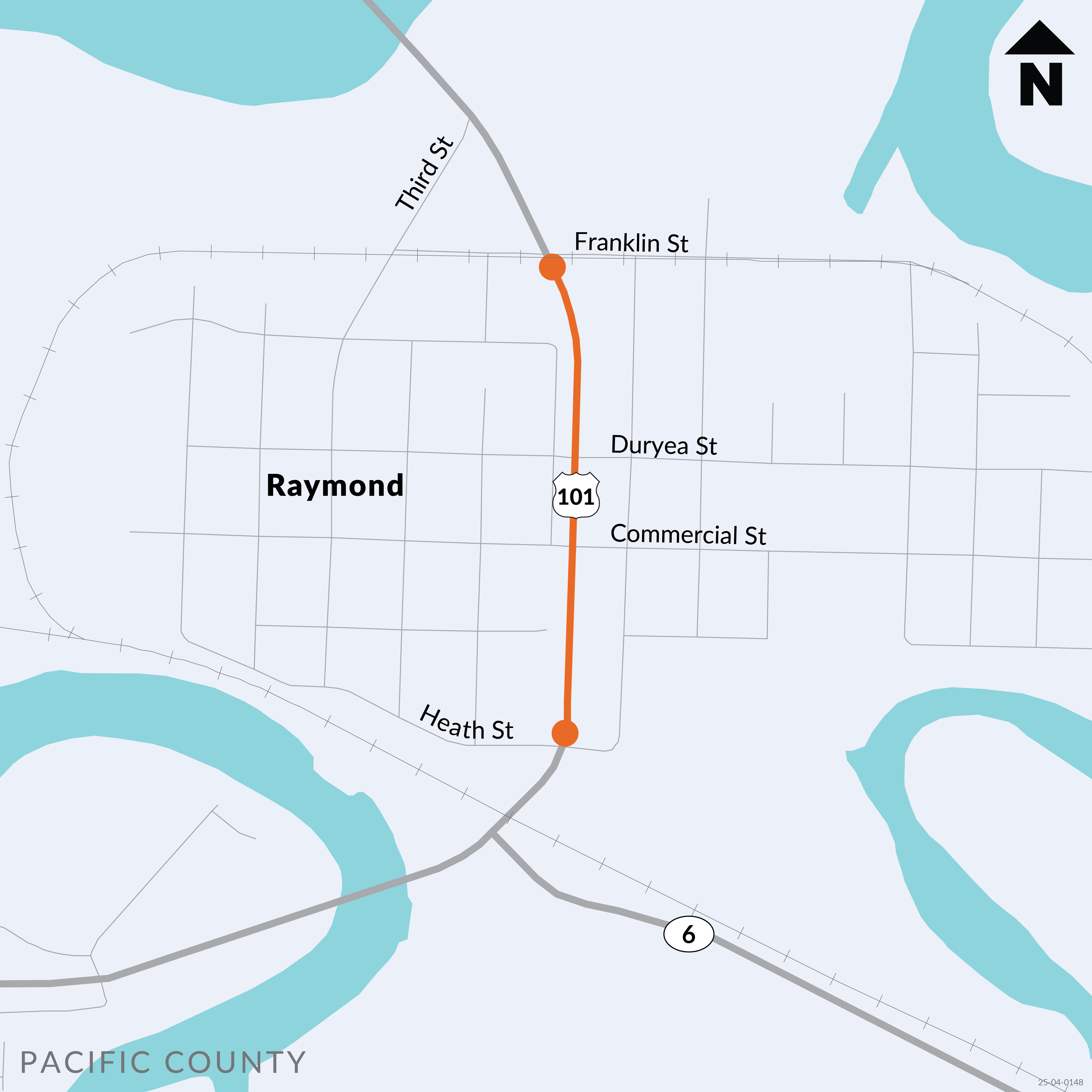
Why we're doing this study and background
Community Concerns:
- Complaints about safely crossing US 101; Traffic not slowing down or allowing bicyclists or pedestrians to cross at crosswalks
City of Raymond requested WSDOT study improvements on US 101
- Study supports Raymond’s Comprehensive Plan goals, which promote safe and efficient transportation improvements for all users
- Safety for all users:
- Narrow sidewalks
- No dedicated biking facilities
- Wide roadway and travel lanes, which make crossing US 101 difficult
- Confusing lane drop at US 101/Heath St.
US 101 through Raymond is a five-lane road, with two lanes in each direction and a center lane for left turns. The width of US 101 makes crossing difficult for those walking, biking and rolling. The roadway has more lanes than needed for current traffic volumes and for what is expected in the future. Roads that are too wide can encourage speeding. Although there are sidewalks on both sides, they are too narrow for the posted speed limits. With narrow sidewalks and fast-moving traffic, it can be improved for pedestrians and cyclists.
As a part of this study, WSDOT recommends possible changes to the roadway, including removing one travel lane in each direction and adding bike lanes, as a part of a future paving project or other roadway work planned within the project area.
Feedback from the first open house
We gathered feedback at a public open house and virtual open house in June 2025 and asked for feedback on what worked and what didn’t. That input helped shape the design alternative options we’re sharing with you today.
Open House #1 Recap
- The first Open House was in July 2025
- We had an in-person and online survey with forty responses
- We received feedback about how the corridor is used and areas of concern
- The main topics from the feedback include:
- Interest for road signage for turning
- Safety improvements at intersections (lighting, crossing distance)
- Concern over losing travel lane, considering the impact on traffic
- Issues with safety crossing intersections
- Concerns of current roundabout, some did not want another
- Current traffic configuration of lane drops is an issue during higher traffic times
- Poor through travel signage leading southbound to roundabout, which causes traffic backup occasionally to Commercial Street during summer months.
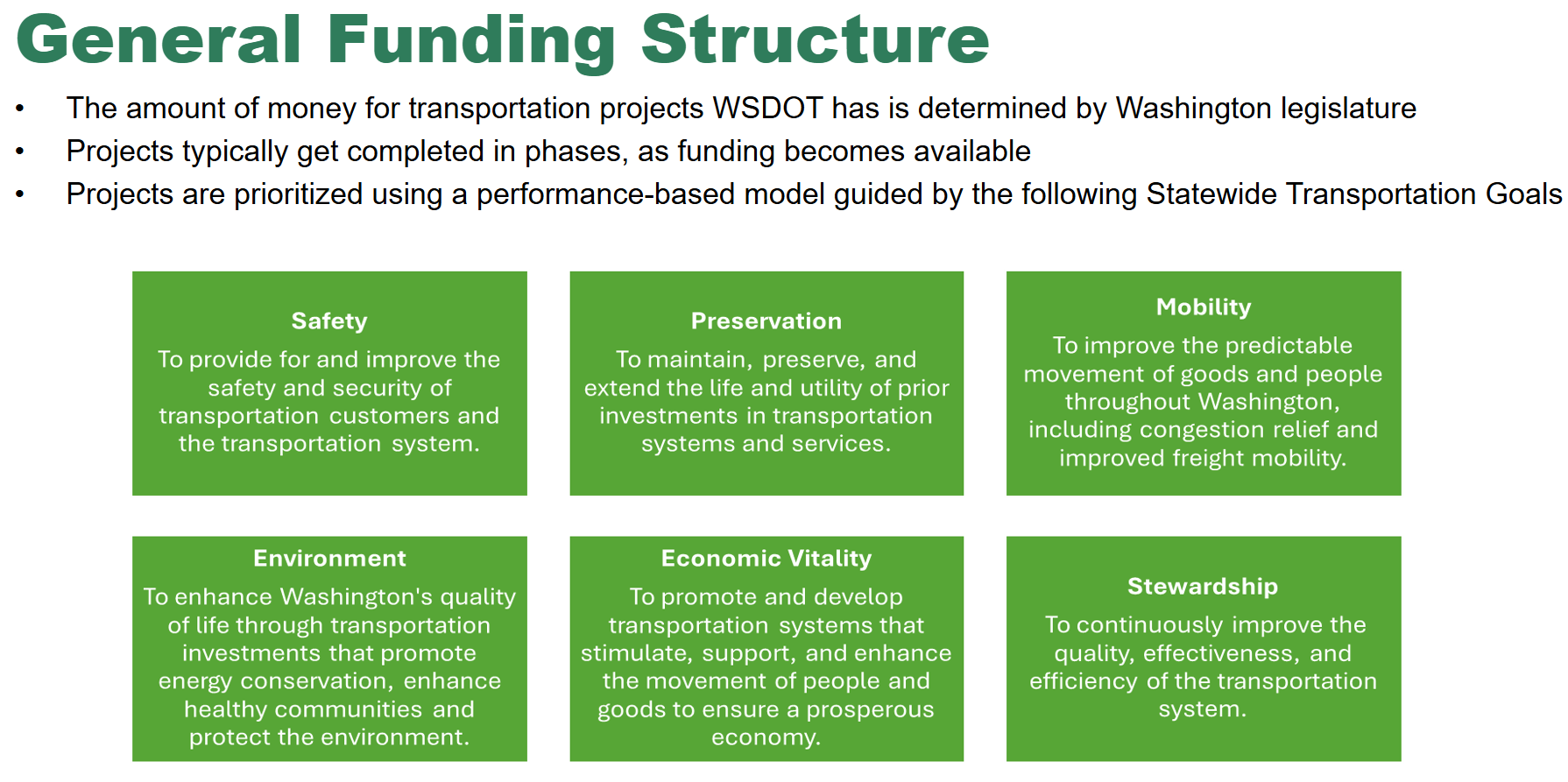
Funding status for US 101
- Currently, there is no funding to complete the alternatives or design options.
- The outcome of the study will be alternatives that meet traffic standards and increase walkability/rideability - accessibility along the corridor.
- To complete the phase of work WSDOT is currently in (study design phase), WSDOT plans to collect more feedback on the current design alternatives so that plans can move forward when funding becomes available.
- In the meantime, WSDOT maintenance crews will keep their eyes on US 101, like they do all state routes, and address any emergency or critical issues as they arise and as funding is available. For more information, visit: https://wsdot.wa.gov/construction-planning/funding
How the design has changed from the feedback we heard
All options reflect the top priorities you shared with us:
- Improving safety and accessibility
- Supporting all types of travelers—whether by car, bike, or on foot
- Reducing traffic congestion, collisions, and maintain traffic flow
We're also considering adding roundabouts at key intersections in both design options. Roundabouts can help calm traffic, improve safety, and keep vehicles flowing more efficiently.
During this open house, you'll see:
- Cross-section graphics that show what each design would look like if you sliced through the road—think of cutting through a piece of fruit, like an orange or tomato.
- The key intersections where roundabouts are being considered.
To wrap up, we’ll ask for your thoughts on the two design options and the possible roundabouts. Your feedback will help guide the final design decisions.
New potential design elements
Roundabouts: What is a roundabout?
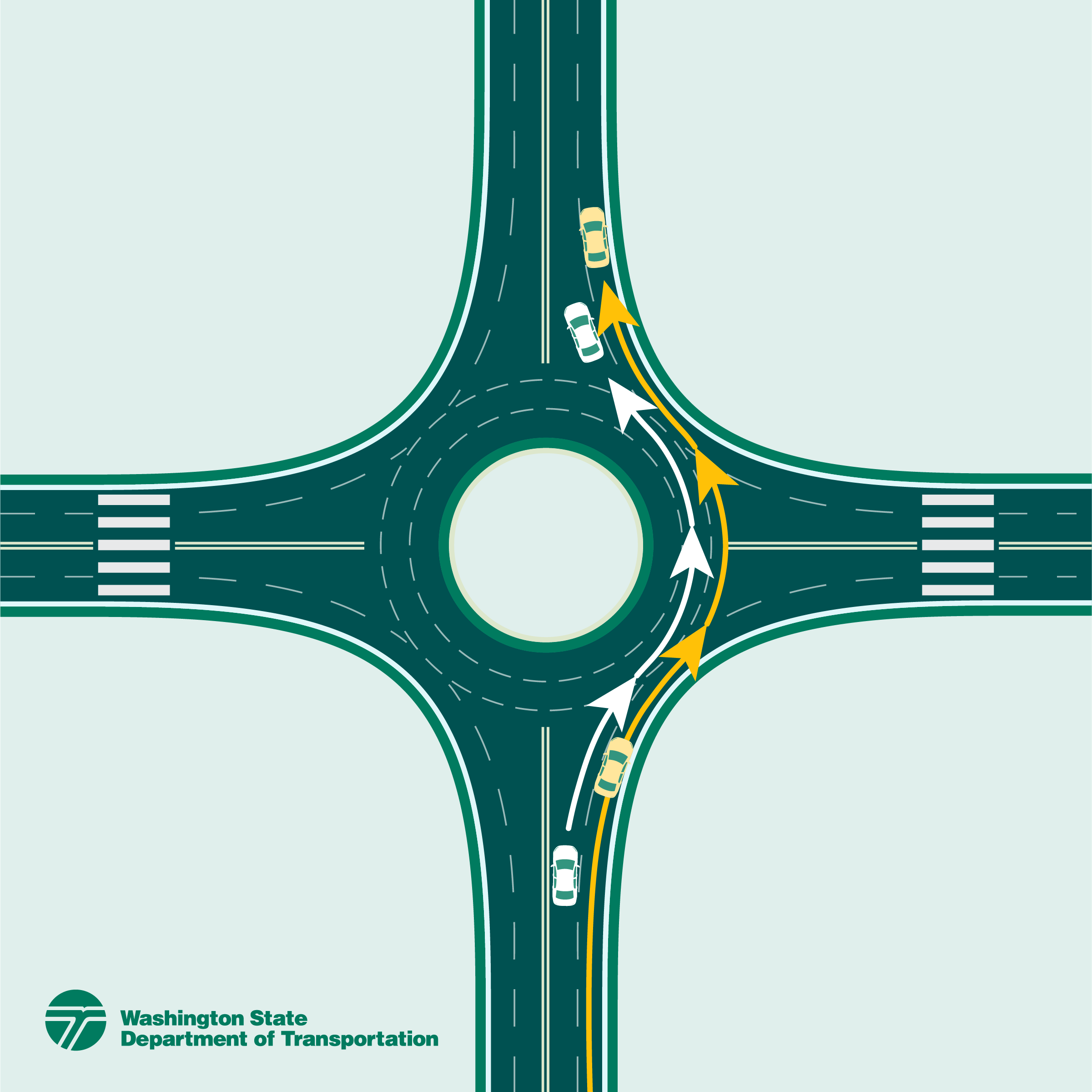
A roundabout is a circular intersection where drivers travel counterclockwise around a center island. There are no traffic signals or stop signs in roundabouts. Drivers entering the roundabout yield to traffic already in the roundabout, then enter the circulating roadway and exit at their desired street, so they function differently from older circular intersection types. Roundabouts are designed to make intersections safer and more efficient for drivers, pedestrians, and bicyclists.
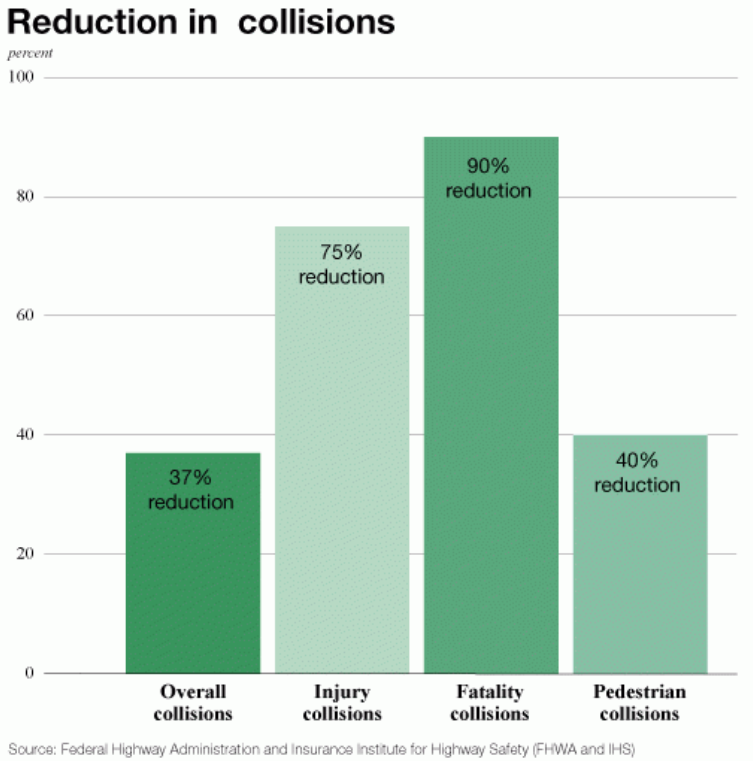
Studies from the Federal Highway Administration show that roundabouts can help traffic flow more efficiently, moving 30 to 50% more vehicles through the intersection than regular intersections. They also slow down traffic to around 15–20 miles per hour, which makes crashes less likely and less severe. These lower speeds help make walking, biking, and using mobility devices like wheelchairs much safer. Roundabouts are also built to handle all types of vehicles, including emergency vehicles, buses, and large trucks with trailers
Additional roundabout information
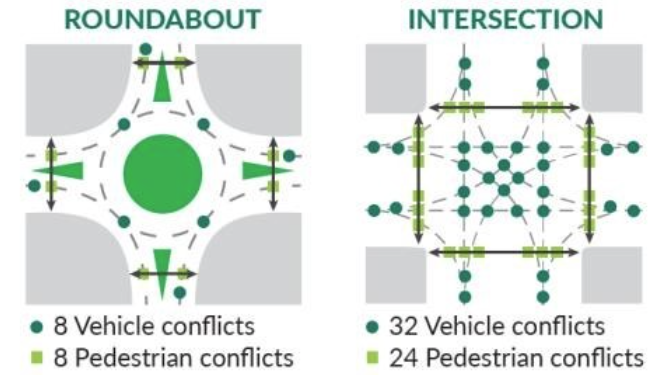
- Roundabouts were shared as a potential option because it is a safter option that helps reduce at angle crashes
- A roundabout will help reduce high-speed, at-angle, also called T-bone collisions—the most common and severe crashes at this site.
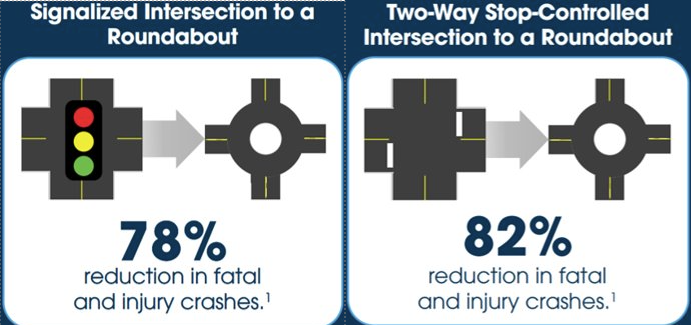
- Modern roundabouts are designed to be safer than traditional intersections for people walking or using mobility assistance devices.
- Bicyclists can choose to ride through the roundabout with traffic or walk their bicycles through the pedestrian crosswalks similar to a traditional intersection. Like people driving, bicyclists must obey the rules of the roundabout as they proceed through the intersection. Riders who choose to walk their bicycles may find that some roundabout designs have a ramp onto the sidewalk, making it easier for bicycles to transition from the roadway to the sidewalk.
Roundabout design will accommodate freight and large vehicles using features like:
- Truck aprons (raised center islands trucks can drive over)
- Mountable curbs and wider turning paths
- Freight users will be consulted in design.
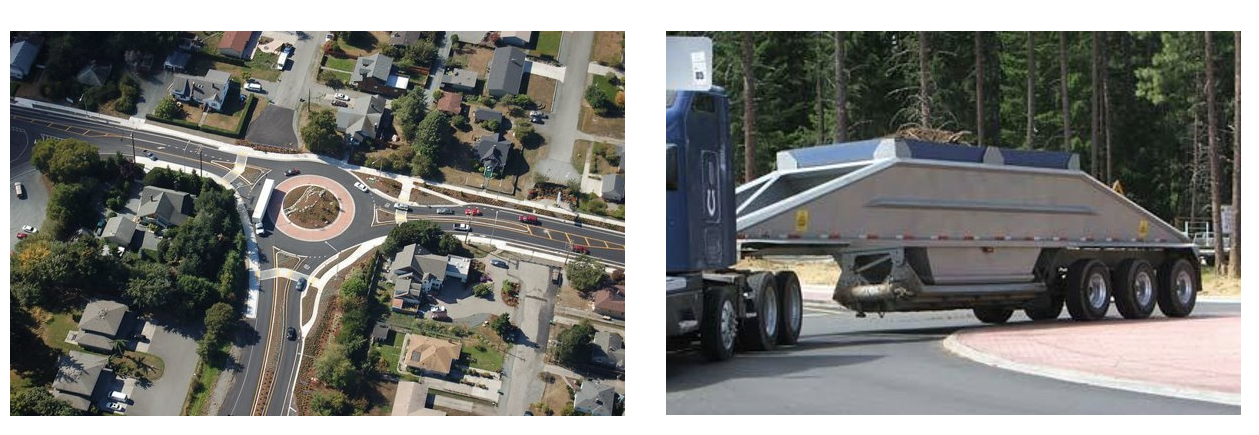
We are exploring adding roundabouts at these intersections to help enhance traffic flow and reduce speeds. We will show you options for the designs with and without roundabouts.
- Franklin Street
- Commercial Street
- Heath Street
Next steps
- We will be sharing preferred design options in late fall/early winter 2025.
- The City of Raymond is part of the WSDOT Safe Route to School Program and will have opportunities to continue sharing your feedback for the area. To learn about that project and opportunities, please visit City of Raymond's website.
Keep in touch
Your feedback is important. We welcome it throughout the project. If you have any questions at any time, Send us your feedback | WSDOT.
To keep up with our construction projects, follow WSDOT's social media platforms and subscribe to WSDOT quarterly newsletters.
Title VI Notice to Public
It is the Washington State Department of Transportation’s (WSDOT) policy to assure that no person shall, on the grounds of race, color, national origin, as provided by Title VI of the Civil Rights Act of 1964, be excluded from participation in, be denied the benefits of, or be otherwise discriminated against under any of its programs and activities. Any person who believes his/her Title VI protection has been violated, may file a complaint with WSDOT’s Office of Equity and Civil Rights (OECR). For additional information regarding Title VI complaint procedures and/or information regarding our non-discrimination obligations, please contact OECR’s Title VI Coordinator at (360) 705-7090.
Americans with Disabilities Act (ADA) Information
This material can be made available in an alternate format by emailing the Office of Equity and Civil Rights at wsdotada@wsdot.wa.gov or by calling toll free, 855-362-4ADA (4232). Persons who are deaf or hard of hearing may make a request by calling the Washington State Relay at 711.
Documents- Alternative options
-
 Alternative 2- Four Lane with Buffered Bike Lanes and Signals (42.5 MB) (png)
-
Alternative 3 - Four Lane with Buffered Bike Lanes and Roundabouts (42 MB) (png)
-
Alternative 4 - Two Lane with Buffered Bike Lanes and Signals (42.6 MB) (png)
-
Alternative 5 - Two Lane with Buffered Bike Lanes and Roundabouts (42.5 MB) (png)
