SR 520 Portage Bay Bridge and Roanoke Lid Project Open House

Share SR 520 Portage Bay Bridge and Roanoke Lid Project Open House on Facebook Share SR 520 Portage Bay Bridge and Roanoke Lid Project Open House on Twitter Share SR 520 Portage Bay Bridge and Roanoke Lid Project Open House on Linkedin Email SR 520 Portage Bay Bridge and Roanoke Lid Project Open House link

Welcome to our online open house!

Major construction for the SR 520 Portage Bay Bridge and Roanoke Lid Project began in November 2024, and things look very different around Portage Bay today!

This open house provides updates on what we've done and what's to come over the next year. As we begin building more permanent elements of this project, we want to keep you informed and answer questions you might have.

Throughout the online open house, you will see visuals of the current conceptual designs. This is a Design-Build project. That means WSDOT completed the project's preliminary design, or "conceptual design." The project's design-builder, Skanska/AECOM, will finish the design and build the project. Because we're continuing to finalize the project design, the completed project may look different than what we are sharing today.

This open house is available until March 3, 2026.

Project overview

Map of major project elements, including new Portage Bay bridges, a new Roanoke Lid and bike connections.Map of major project elements.

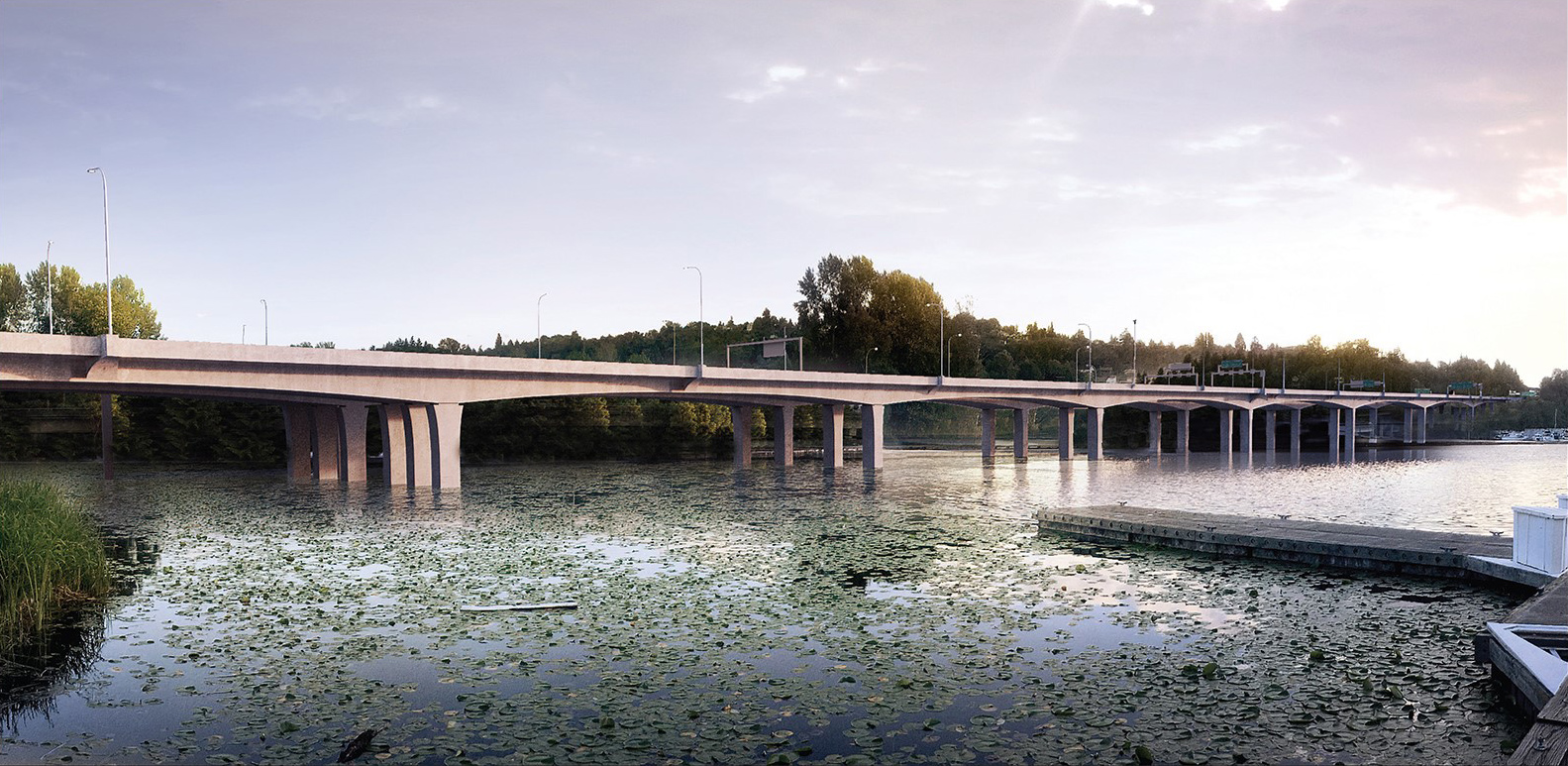
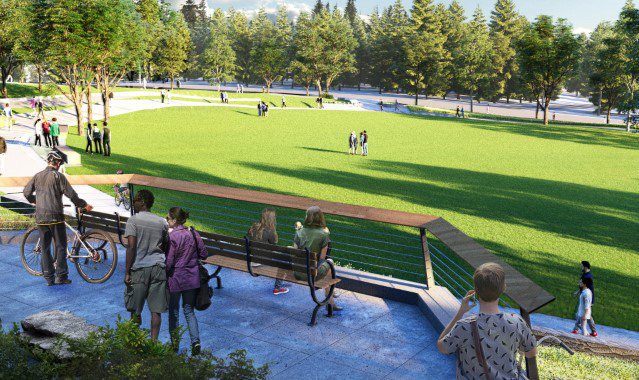
The Portage Bay Bridge and Roanoke Lid Project will replace the old, structurally vulnerable Portage Bay Bridge with two parallel, seismically resilient bridges. The project will also build a landscaped lid over SR 520 between 10th Avenue East and Delmar Drive East, complete the highway's transit/HOV system between the Eastside and Seattle, and extend the regional SR 520 Trail across Portage Bay to the lid and local trails.


Project schedule

Construction began in November 2024. The project is expected to be completed in 2031. The construction schedule is subject to change.

Construction timeline chart from 2024 to 2031 with various project timelines, a “We are here” highlight at Q4 2025 and project completion in 2031.*The in-water impact piledriving season lasts from September 1 to April 30. We will continue vibratory piledriving and have limited on-land impact piledriving year-round. Please note: Construction schedule is subject to change.


Construction progress – 2024-2025

Watch this short video to see how much progress we've made since starting the project in November 2024.


Piledriving progress

Since we started piledriving in fall 2024, we've installed over 300 temporary piles in Portage Bay – that's about half of the total piles we need for the project based on our current design! For the next few years, we'll continue installing piles in and around Portage Bay using both impact and vibratory hammers. The 2024-2025 in-water piledriving season was our busiest season, and we expect less piledriving in future seasons.

Did you know that it's not just in Portage Bay where we're installing piles? We also have piles to install near the Bill Dawson Trail, and will install piles for temporary on- and off-ramps which we'll discuss later in this open house.

Ongoing piledriving in Portage Bay

Our second season of in-water impact piledriving began in September and will continue through April 30, 2026. We expect to install around 150 piles in Portage Bay this season.

Typical impact piledriving hours are 8 a.m. to 5 p.m. on weekdays and 9 a.m. to 5 p.m. on weekends, though we may work later into the evening if needed. We'll notify neighbors with email updates if our schedule changes.

We'll continue vibrating piles around the project area year-round. See the map below for where we are installing piles during Season 2.

Map of Portage Bay and SR 520 piledriving areas. A green area indicates completed piledriving for the work trestle and purple indicates upcoming piledriving at the east and west ends of the trestle.
Map of current and upcoming piledriving activities.

MORE ABOUT OUR PILEDRIVING SCHEDULE

Our in-water impact piledriving seasons begin in September and end in April. These seasons align with the "fish window" in Portage Bay. A "fish window" is a specific time frame when in-water impact piledriving is allowed in order to minimize harm to fish populations. These windows are set by regulatory agencies, like the Department of Fish and Wildlife, and are based on when fish are least likely to spawn or migrate in a particular waterway.

While we're not allowed to drive piles in the water with an impact hammer outside of the fish window, we are allowed to use an impact hammer on land and a vibratory hammer in the water year-round.

Understanding our piledriving methods

Why we use different piledriving techniques

The piledriving method we use to install our piles depends on the type of the soil at the bottom of Portage Bay. We need to install each pile deep into the lakebed, so it is strong enough to support the weight of the work trestle surface, our crews and equipment.

The lakebed beneath Portage Bay contains both soft sediments and hard clay layers at different depths and locations. Our crews test the soil at each pile location and choose the right piledriving method based on the underground conditions. We use impact piledriving when we need to install piles through tough clay layers.

Crews working for WSDOT's Colman Dock Project use a vibratory hammer to vibrate the pile into the ground. After a certain depth, the soil may be too hard to vibrate and will need to be installed with an impact hammering.

Vibratory piledriving

Vibratory hammers use rapid vibrations to "shake" piles into the ground through soft soils and sediments. This method produces continuous sound and vibration. In Portage Bay's softer clay and sediment layers, vibrations help the pile slip through the soil with less resistance. To reduce noise in the neighborhood, we use vibratory piledriving whenever possible.

Crews working for WSDOT's Colman Dock Project use an impact hammer to drive a pile into hard soil.

Impact piledriving

Impact hammers use a heavy weight that repeatedly strikes the top of the pile, driving it through harder soil. While this method produces a sharp noise, it's the only effective way to install piles through Portage Bay's stubborn clay layers that won't give to vibration alone.

See what's below the surface in Portage Bay

These cross-section diagrams show what our construction crews might find beneath Portage Bay. The diagram on the left demonstrates soft sediment layers where vibratory piledriving can effectively shake piles into place. The diagram on the right shows dense clay layers that require impact piledriving to push through. Our steel piles are 30 inches in diameter and 100 feet long on average. We drive them into the ground until they hit dense clay or until they are deep enough to hold heavy loads.

We use different piledriving methods – or even a combination of both methods – depending on the soil conditions we find at each location in Portage Bay. See the diagrams below for typical underground conditions that shape our piledriving approach.

Cross-section diagram of a steel pile through water, lake bottom, soft clay and bedrock clay.
Diagram of conditions where crews use vibratory piledriving to install piles through soft clay.
Cross-section diagram of a steel pile through water, lake bottom, soft clay, tough clay and bedrock clay.
Diagram of conditions where crews use vibratory piledriving followed by impact piledriving to complete the installation through tough clay.

Building the new Portage Bay bridges

Building the bridge foundation

A series of structures called "drilled shafts" will provide the foundation of the new Portage Bay bridges. A drilled shaft uses a larger type of pile installed deep into the clay layer beneath the lake. The casing forms the outer shells of the drilled shafts. The casings are hollow on the inside and larger than our steel piles, approximately 12' feet in diameter. To build the bridge foundation, we will:

  1. Vibrate the casing deep into the bottom of the lake using a vibratory hammer.
  2. Remove the soil from the inside of each casing by using a crane-mounted cylindrical drill (or hammer grab depending on soil conditions). The hollow casings form shafts deep into the ground.
  3. Place a rebar support cage into each shaft. The rebar will help strengthen the foundation.
  4. Fill the shaft with concrete using concrete trucks and pump trucks.
  5. Build and install bridge piers (vertical bridge posts) on top of the drilled shafts. We will use structural forms, reinforced steel and concrete to build each pier.
  6. After the bridge piers are complete, we will install the horizontal bridge superstructures (girders, decks/surfaces, etc.) on the bridge piers.

These photos are from the SR 520 West Approach Bridge North project. Crews will use the same techniques and equipment to install the drilled shafts for the Portage Bay bridges.

A steel casing lowered into water by a crane.
A crane lowers a drilled shaft casing into place.


A closer view of a steel casing lowered into water by a crane
A closer view of a crane lowering a drilled shaft casing into place.


A vibratory hammer attached to the top of a steel casing.
Crews use a vibratory hammer to vibrate the casing into the soil.
 Drilled shaft 4 A casing vibrated to its final depth just a few feet above the water level. The top of a steel casing a few feet above the surface of the water.
A casing vibrated to its final depth just a few feet above the water level.


A cylindrical drill on a work trestle removing soil from a steel casing.
A cylindrical drill used to collect and remove soil from inside the casing.
A cylindrical drill dumping soil into a container.
A closer view of a cylindrical drill dumping soil removed from within a casing.
A drilling rig on a work trestle sitting above two casings.
A cylindrical drill moving from one casing to the next. The drilling operation will be conducted for each drilled shaft casing.


A drill with a scoop is suspended by a crane above a steel casing.
Crews using a different type of drill to remove soil from a casing. Depending on the conditions of soil inside each casing, different types of equipment may be used.


Two workers tying rebar inside a large cylindrical rebar cage.
Crews build a rebar cage that will be placed inside a drilled shaft. The rebar provides additional strength to the concrete that will be poured into the shaft.
Two cranes on a work trestle lower a rebar cage into an empty casing.
Cranes lowering a rebar cage into an empty shaft casing.


Two concrete trucks and a pump truck on a work trestle fill a drilled shaft with concrete. Nearby, a rig drills soil from another shaft. A label describes how concrete pumping and drilling operations may take place at the same time.
Concrete trucks pump concrete into a shaft after the rebar cage has been installed. On the right side of the photo, another crew drills soil from a shaft. Crews will conduct multiple types of operations, like pumping concrete and drilling, at the same time.


Two workers on top of the concrete filling inside a casing.
A view inside a shaft filled with concrete. The top surface of the concrete and the rebar cage is visible.
Concrete column piers built onto the top of drilled shaft casings emerging from the water.
Three column piers built into the top of drilled shafts. The new bridges will be built on piers like these.


FINALIZING THE DESIGN FOR THE NEW BRIDGES

We are working to finish the design for the two bridges that will replace the existing Portage Bay bridge. Each bridge will have about 25 drilled shafts in the water. Each drilled shaft has an average casing length of 200 feet and a diameter of 12 feet. We will also install more than 100 drilled shafts on land to support structures such as retaining walls. This design is subject to change. We will share more information on the design during our monthly construction meetings once it is finalized.

Upcoming construction

New temporary overpass near Roanoke Park

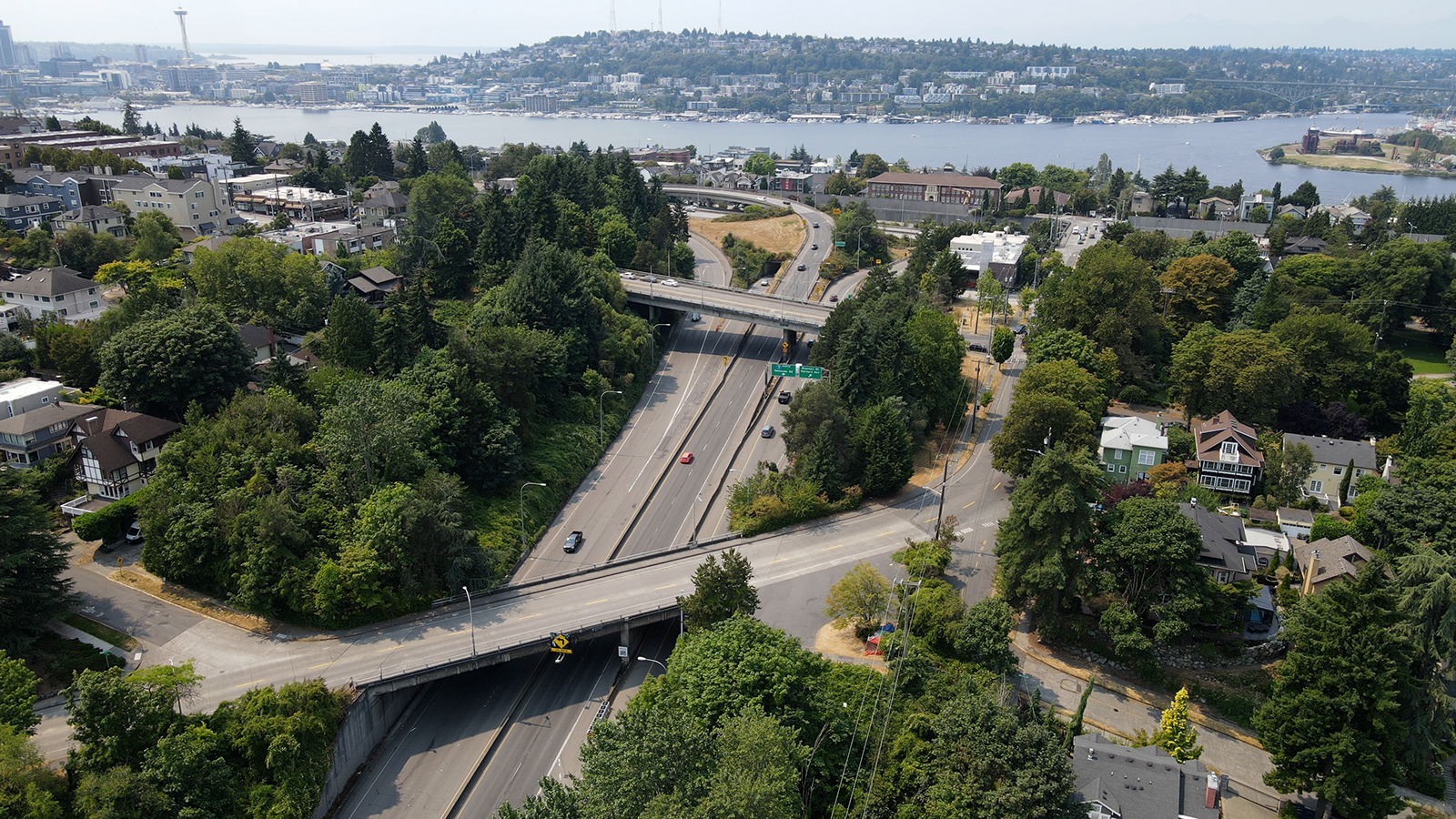
In late 2027, crews will make a big change to build the new Roanoke lid. We will remove and replace the existing 10th Avenue East and Delmar Drive East overpasses above SR 520 near Roanoke Park. The new overpasses will be incorporated into the lid structure.

To keep traffic moving during the overpass removal and replacement, we'll build a new temporary overpass. This temporary overpass will be between the existing 10th Avenue East and Delmar Drive East overpasses. We'll also build new temporary access roads from 10th Avenue East and Delmar Drive East. Once completed, we will shift traffic onto the temporary access roads and overpass for several years.

See the visual below to get an idea of how the temporary overpass will work. The exact location and phasing of this work is still under development, but it's important for neighbors and drivers to know this traffic change is coming.

Digital rendering showing the new temporary overpass over SR 520 and the closure of the 10th Avenue East and Delmar Drive East overpasses.
A conceptual rendering showing the removal of the existing 10th Avenue East and Delmar Drive East overpasses and an approximate location for the temporary crossing over SR 520.


Shifting eastbound traffic on SR 520

Over the summer, crews installed several piles on land near the existing eastbound SR 520 off-ramp to Montlake Boulevard. These piles will support a new temporary off-ramp that will open to traffic in 2026.

WHAT TO EXPECT

  • Some nighttime work so crews can build the surface of the new temporary off-ramp.
  • We will fully close eastbound SR 520 over Portage Bay for at least four separate weekends and on some weeknights.
  • Once construction of the temporary off-ramp is complete, we will reroute traffic onto the ramp in 2026.
A map of SR 520 showing the existing off-ramp to Montlake Boulevard East, the temporary work trestle and the piles that will support the future temporary off-ramp.
Existing conditions of the eastbound SR 520 off-ramp to Montlake Boulevard
A map of SR 520 showing the location of the future temporary off-ramp to Montlake Boulevard East and the closed existing off-ramp.
Future temporary eastbound SR 520 off-ramp to Montlake Boulevard


Construction near Portage Bay and Roanoke Park neighborhoods

Select tree and vegetation removal

In September 2025, we updated our Tree and Vegetation Management and Protection Plan (TVMPP). You can view those updates on our Construction Corner webpage.

We initially identified trees for removal in the July 2024 TVMPP based on WSDOT's conceptual design. As Skanska furthered the design, they identified additional trees that need to be removed for several reasons, including:

  • Construction of the Harvard Connection bike and pedestrian path
  • Reconstruction of the East Roanoke Street/Delmar Drive East/11th Avenue East intersection, including future sidewalk, ADA ramp, curb and planter area improvements.
  • Utility connections along East Roanoke Street, west of the Delmar overpass, and near the Boyer Stairs
  • Design refinements to the Roanoke lid area and some of the lid's stair and ramp connections

We understand that trees and natural areas are very important to the city and nearby neighbors. We try to limit tree removal as much as possible, while still providing construction crews with the space needed to build the project.

The city of Seattle requires each tree removed within its right-of-way to be replaced with an approximate 2:1 ratio. This means that by the end of the project, we will have replaced and replanted more trees than we removed. You can read more about our process and policies for removing and replacing trees in our Tree and Vegetation Removal FAQ.

Map of Portage Bay and SR 520 tree removal areas. Green areas around Boyer Avenue East and East Roanoke Street indicate where trees are currently being removed. Orange areas around Montlake Boulevard East, I-5 and Boyer Avenue East indicate where trees will be removed in the future. Grey areas around Montlake Boulevard East indicate where trees have already been removed.
Map of areas where select trees will be removed

A green placard with a label to protect the tree.Tree protection noticeA yellow placard with a notice that the tree is proposed for removal and replacement.Tree removal notice

Nighttime construction

Before construction began, the city of Seattle granted WSDOT and Skanska a Major Public Project Construction Noise Variance that sets limits for the allowable level of nighttime construction noise. We will get a Temporary Noise Variance when nighttime work is expected to exceed those limits. We'll also notify nearby neighbors in advance when the night work is expected to be loud and close to homes.

NOISE REDUCTION AND MONITORING:

  • Crews will install temporary noise screens (called "acoustifences") for lid construction and around the WSDOT staging areas. These will be installed as the project progresses.
  • Pure-tone backup alarms (the loud "beep, beep, beep" trucks often make when driving in reverse) are prohibited.
  • Electronic noise meters record noise levels 24 hours a day and send real-time alerts to the project team when noise goes over the allowable levels.
  • Weekly nighttime noise reports are available to the public on the SR 520 Construction Corner webpage.
  • An independent noise inspector on site during all nighttime work to report any violations or stop construction work as needed.
  • Other requirements as listed in the Community Construction Management Plan.
NIGHTTIME HOURS WHEN VARIANCE IS APPLICABLE:
Weekdays: 10 p.m. to 7 a.m.
Weekends: 10 p.m. to 9 a.m.
For more information about the project's Major Public Project Construction Noise Variance visit sr520construction.com

Nighttime road construction scene with workers, an excavator and traffic barrels near a highway overpass.
Crews move temporary traffic barriers on SR 520 at night.

Nighttime road construction scene with workers, a truck and machinery moving a concrete traffic block.
Crews work overnight on SR 520.


New haul road connections and keeping people safe

To move materials and equipment to and from the temporary work trestles, we are building three temporary haul roads. These haul roads will connect the work trestle to existing streets at the following locations:

  • Montlake Boulevard East will connect to the northeast corner of the work trestle.
  • East Roanoke Street will connect to the southeast corner of the work trestle.
  • Boyer Avenue East will connect to the southwest corner of the work trestle.

Haul roads on east side of the project

The haul road connecting Montlake Boulevard East to the northeast corner of the work trestle is now complete. We are currently building the haul road that will connect East Roanoke Street to the southeast corner of the work trestle. Crews are scheduled to begin using these new haul roads in 2026.

A map of the east side of Portage Bay and SR 520 showing two new haul roads. One connects the north side of the work trestle to Montlake Boulevard East, the other connects the south side of the trestle to East Roanoke Street.
Map showing the locations of the new haul routes that will connect to the temporary work trestle on the east side of the project area.

Haul roads on west side of the project

We need to install about 20 piles in the area to extend the trestle before we build the haul road. We will begin piledriving in this area in early 2026 and continue through April 30, 2026. As the piles are installed and cut to the correct height, we will extend the deck of the work trestle, install a retaining wall on the hillside east of Boyer Avenue East and build the road connection to Boyer Avenue East.

 14 west haul road Map showing the location of the new haul route that will connect to the temporary work trestle on the west side of the project area. A map of the west side of Portage Bay and SR 520 showing where a new haul road will connect the south side of the work trestle to Boyer Avenue East.Map showing the location of the new haul route that will connect to the temporary work trestle on the west side of the project area.

The entrance to each haul road will be clearly marked with signs and cones. Because the entrance to the haul road on Montlake Boulevard East is next to the Montlake Boulevard on-ramp to westbound SR 520, we'll add the following additional safety measures to protect people traveling through this area:

  • Construction fencing around active work areas
  • "Construction Vehicles Only" signs near the haul road entrance
  • Orange cones to separate the haul road entrance from the southbound Montlake Boulevard travel lanes and the westbound on-ramp entrance
  • Orange cones across the haul road entrance to provide a clear path for pedestrians
  • Flaggers on site to direct heavy trucks and larger vehicles to and from the haul road

15 haul road Cones, signs and fencing separating the haul road entrance from southbound traffic on Montlake Boulevard East. A fenced haul road entrance with traffic cones and warning signs.
Map of the haul road entrance on Montlake Boulevard East.


Stay in touch

Thank you for taking the time to visit our online open house! We're committed to keeping you and your neighbors up to date on construction progress and what you can expect.

For questions and more information:

Welcome to our online open house!

Major construction for the SR 520 Portage Bay Bridge and Roanoke Lid Project began in November 2024, and things look very different around Portage Bay today!

This open house provides updates on what we've done and what's to come over the next year. As we begin building more permanent elements of this project, we want to keep you informed and answer questions you might have.

Throughout the online open house, you will see visuals of the current conceptual designs. This is a Design-Build project. That means WSDOT completed the project's preliminary design, or "conceptual design." The project's design-builder, Skanska/AECOM, will finish the design and build the project. Because we're continuing to finalize the project design, the completed project may look different than what we are sharing today.

This open house is available until March 3, 2026.

Project overview

Map of major project elements, including new Portage Bay bridges, a new Roanoke Lid and bike connections.Map of major project elements.

The Portage Bay Bridge and Roanoke Lid Project will replace the old, structurally vulnerable Portage Bay Bridge with two parallel, seismically resilient bridges. The project will also build a landscaped lid over SR 520 between 10th Avenue East and Delmar Drive East, complete the highway's transit/HOV system between the Eastside and Seattle, and extend the regional SR 520 Trail across Portage Bay to the lid and local trails.


Project schedule

Construction began in November 2024. The project is expected to be completed in 2031. The construction schedule is subject to change.

Construction timeline chart from 2024 to 2031 with various project timelines, a “We are here” highlight at Q4 2025 and project completion in 2031.*The in-water impact piledriving season lasts from September 1 to April 30. We will continue vibratory piledriving and have limited on-land impact piledriving year-round. Please note: Construction schedule is subject to change.


Construction progress – 2024-2025

Watch this short video to see how much progress we've made since starting the project in November 2024.


Piledriving progress

Since we started piledriving in fall 2024, we've installed over 300 temporary piles in Portage Bay – that's about half of the total piles we need for the project based on our current design! For the next few years, we'll continue installing piles in and around Portage Bay using both impact and vibratory hammers. The 2024-2025 in-water piledriving season was our busiest season, and we expect less piledriving in future seasons.

Did you know that it's not just in Portage Bay where we're installing piles? We also have piles to install near the Bill Dawson Trail, and will install piles for temporary on- and off-ramps which we'll discuss later in this open house.

Ongoing piledriving in Portage Bay

Our second season of in-water impact piledriving began in September and will continue through April 30, 2026. We expect to install around 150 piles in Portage Bay this season.

Typical impact piledriving hours are 8 a.m. to 5 p.m. on weekdays and 9 a.m. to 5 p.m. on weekends, though we may work later into the evening if needed. We'll notify neighbors with email updates if our schedule changes.

We'll continue vibrating piles around the project area year-round. See the map below for where we are installing piles during Season 2.

Map of Portage Bay and SR 520 piledriving areas. A green area indicates completed piledriving for the work trestle and purple indicates upcoming piledriving at the east and west ends of the trestle.
Map of current and upcoming piledriving activities.

MORE ABOUT OUR PILEDRIVING SCHEDULE

Our in-water impact piledriving seasons begin in September and end in April. These seasons align with the "fish window" in Portage Bay. A "fish window" is a specific time frame when in-water impact piledriving is allowed in order to minimize harm to fish populations. These windows are set by regulatory agencies, like the Department of Fish and Wildlife, and are based on when fish are least likely to spawn or migrate in a particular waterway.

While we're not allowed to drive piles in the water with an impact hammer outside of the fish window, we are allowed to use an impact hammer on land and a vibratory hammer in the water year-round.

Understanding our piledriving methods

Why we use different piledriving techniques

The piledriving method we use to install our piles depends on the type of the soil at the bottom of Portage Bay. We need to install each pile deep into the lakebed, so it is strong enough to support the weight of the work trestle surface, our crews and equipment.

The lakebed beneath Portage Bay contains both soft sediments and hard clay layers at different depths and locations. Our crews test the soil at each pile location and choose the right piledriving method based on the underground conditions. We use impact piledriving when we need to install piles through tough clay layers.

Crews working for WSDOT's Colman Dock Project use a vibratory hammer to vibrate the pile into the ground. After a certain depth, the soil may be too hard to vibrate and will need to be installed with an impact hammering.

Vibratory piledriving

Vibratory hammers use rapid vibrations to "shake" piles into the ground through soft soils and sediments. This method produces continuous sound and vibration. In Portage Bay's softer clay and sediment layers, vibrations help the pile slip through the soil with less resistance. To reduce noise in the neighborhood, we use vibratory piledriving whenever possible.

Crews working for WSDOT's Colman Dock Project use an impact hammer to drive a pile into hard soil.

Impact piledriving

Impact hammers use a heavy weight that repeatedly strikes the top of the pile, driving it through harder soil. While this method produces a sharp noise, it's the only effective way to install piles through Portage Bay's stubborn clay layers that won't give to vibration alone.

See what's below the surface in Portage Bay

These cross-section diagrams show what our construction crews might find beneath Portage Bay. The diagram on the left demonstrates soft sediment layers where vibratory piledriving can effectively shake piles into place. The diagram on the right shows dense clay layers that require impact piledriving to push through. Our steel piles are 30 inches in diameter and 100 feet long on average. We drive them into the ground until they hit dense clay or until they are deep enough to hold heavy loads.

We use different piledriving methods – or even a combination of both methods – depending on the soil conditions we find at each location in Portage Bay. See the diagrams below for typical underground conditions that shape our piledriving approach.

Cross-section diagram of a steel pile through water, lake bottom, soft clay and bedrock clay.
Diagram of conditions where crews use vibratory piledriving to install piles through soft clay.
Cross-section diagram of a steel pile through water, lake bottom, soft clay, tough clay and bedrock clay.
Diagram of conditions where crews use vibratory piledriving followed by impact piledriving to complete the installation through tough clay.

Building the new Portage Bay bridges

Building the bridge foundation

A series of structures called "drilled shafts" will provide the foundation of the new Portage Bay bridges. A drilled shaft uses a larger type of pile installed deep into the clay layer beneath the lake. The casing forms the outer shells of the drilled shafts. The casings are hollow on the inside and larger than our steel piles, approximately 12' feet in diameter. To build the bridge foundation, we will:

  1. Vibrate the casing deep into the bottom of the lake using a vibratory hammer.
  2. Remove the soil from the inside of each casing by using a crane-mounted cylindrical drill (or hammer grab depending on soil conditions). The hollow casings form shafts deep into the ground.
  3. Place a rebar support cage into each shaft. The rebar will help strengthen the foundation.
  4. Fill the shaft with concrete using concrete trucks and pump trucks.
  5. Build and install bridge piers (vertical bridge posts) on top of the drilled shafts. We will use structural forms, reinforced steel and concrete to build each pier.
  6. After the bridge piers are complete, we will install the horizontal bridge superstructures (girders, decks/surfaces, etc.) on the bridge piers.

These photos are from the SR 520 West Approach Bridge North project. Crews will use the same techniques and equipment to install the drilled shafts for the Portage Bay bridges.

A steel casing lowered into water by a crane.
A crane lowers a drilled shaft casing into place.


A closer view of a steel casing lowered into water by a crane
A closer view of a crane lowering a drilled shaft casing into place.


A vibratory hammer attached to the top of a steel casing.
Crews use a vibratory hammer to vibrate the casing into the soil.
 Drilled shaft 4 A casing vibrated to its final depth just a few feet above the water level. The top of a steel casing a few feet above the surface of the water.
A casing vibrated to its final depth just a few feet above the water level.


A cylindrical drill on a work trestle removing soil from a steel casing.
A cylindrical drill used to collect and remove soil from inside the casing.
A cylindrical drill dumping soil into a container.
A closer view of a cylindrical drill dumping soil removed from within a casing.
A drilling rig on a work trestle sitting above two casings.
A cylindrical drill moving from one casing to the next. The drilling operation will be conducted for each drilled shaft casing.


A drill with a scoop is suspended by a crane above a steel casing.
Crews using a different type of drill to remove soil from a casing. Depending on the conditions of soil inside each casing, different types of equipment may be used.


Two workers tying rebar inside a large cylindrical rebar cage.
Crews build a rebar cage that will be placed inside a drilled shaft. The rebar provides additional strength to the concrete that will be poured into the shaft.
Two cranes on a work trestle lower a rebar cage into an empty casing.
Cranes lowering a rebar cage into an empty shaft casing.


Two concrete trucks and a pump truck on a work trestle fill a drilled shaft with concrete. Nearby, a rig drills soil from another shaft. A label describes how concrete pumping and drilling operations may take place at the same time.
Concrete trucks pump concrete into a shaft after the rebar cage has been installed. On the right side of the photo, another crew drills soil from a shaft. Crews will conduct multiple types of operations, like pumping concrete and drilling, at the same time.


Two workers on top of the concrete filling inside a casing.
A view inside a shaft filled with concrete. The top surface of the concrete and the rebar cage is visible.
Concrete column piers built onto the top of drilled shaft casings emerging from the water.
Three column piers built into the top of drilled shafts. The new bridges will be built on piers like these.


FINALIZING THE DESIGN FOR THE NEW BRIDGES

We are working to finish the design for the two bridges that will replace the existing Portage Bay bridge. Each bridge will have about 25 drilled shafts in the water. Each drilled shaft has an average casing length of 200 feet and a diameter of 12 feet. We will also install more than 100 drilled shafts on land to support structures such as retaining walls. This design is subject to change. We will share more information on the design during our monthly construction meetings once it is finalized.

Upcoming construction

New temporary overpass near Roanoke Park

In late 2027, crews will make a big change to build the new Roanoke lid. We will remove and replace the existing 10th Avenue East and Delmar Drive East overpasses above SR 520 near Roanoke Park. The new overpasses will be incorporated into the lid structure.

To keep traffic moving during the overpass removal and replacement, we'll build a new temporary overpass. This temporary overpass will be between the existing 10th Avenue East and Delmar Drive East overpasses. We'll also build new temporary access roads from 10th Avenue East and Delmar Drive East. Once completed, we will shift traffic onto the temporary access roads and overpass for several years.

See the visual below to get an idea of how the temporary overpass will work. The exact location and phasing of this work is still under development, but it's important for neighbors and drivers to know this traffic change is coming.

Digital rendering showing the new temporary overpass over SR 520 and the closure of the 10th Avenue East and Delmar Drive East overpasses.
A conceptual rendering showing the removal of the existing 10th Avenue East and Delmar Drive East overpasses and an approximate location for the temporary crossing over SR 520.


Shifting eastbound traffic on SR 520

Over the summer, crews installed several piles on land near the existing eastbound SR 520 off-ramp to Montlake Boulevard. These piles will support a new temporary off-ramp that will open to traffic in 2026.

WHAT TO EXPECT

  • Some nighttime work so crews can build the surface of the new temporary off-ramp.
  • We will fully close eastbound SR 520 over Portage Bay for at least four separate weekends and on some weeknights.
  • Once construction of the temporary off-ramp is complete, we will reroute traffic onto the ramp in 2026.
A map of SR 520 showing the existing off-ramp to Montlake Boulevard East, the temporary work trestle and the piles that will support the future temporary off-ramp.
Existing conditions of the eastbound SR 520 off-ramp to Montlake Boulevard
A map of SR 520 showing the location of the future temporary off-ramp to Montlake Boulevard East and the closed existing off-ramp.
Future temporary eastbound SR 520 off-ramp to Montlake Boulevard


Construction near Portage Bay and Roanoke Park neighborhoods

Select tree and vegetation removal

In September 2025, we updated our Tree and Vegetation Management and Protection Plan (TVMPP). You can view those updates on our Construction Corner webpage.

We initially identified trees for removal in the July 2024 TVMPP based on WSDOT's conceptual design. As Skanska furthered the design, they identified additional trees that need to be removed for several reasons, including:

  • Construction of the Harvard Connection bike and pedestrian path
  • Reconstruction of the East Roanoke Street/Delmar Drive East/11th Avenue East intersection, including future sidewalk, ADA ramp, curb and planter area improvements.
  • Utility connections along East Roanoke Street, west of the Delmar overpass, and near the Boyer Stairs
  • Design refinements to the Roanoke lid area and some of the lid's stair and ramp connections

We understand that trees and natural areas are very important to the city and nearby neighbors. We try to limit tree removal as much as possible, while still providing construction crews with the space needed to build the project.

The city of Seattle requires each tree removed within its right-of-way to be replaced with an approximate 2:1 ratio. This means that by the end of the project, we will have replaced and replanted more trees than we removed. You can read more about our process and policies for removing and replacing trees in our Tree and Vegetation Removal FAQ.

Map of Portage Bay and SR 520 tree removal areas. Green areas around Boyer Avenue East and East Roanoke Street indicate where trees are currently being removed. Orange areas around Montlake Boulevard East, I-5 and Boyer Avenue East indicate where trees will be removed in the future. Grey areas around Montlake Boulevard East indicate where trees have already been removed.
Map of areas where select trees will be removed

A green placard with a label to protect the tree.Tree protection noticeA yellow placard with a notice that the tree is proposed for removal and replacement.Tree removal notice

Nighttime construction

Before construction began, the city of Seattle granted WSDOT and Skanska a Major Public Project Construction Noise Variance that sets limits for the allowable level of nighttime construction noise. We will get a Temporary Noise Variance when nighttime work is expected to exceed those limits. We'll also notify nearby neighbors in advance when the night work is expected to be loud and close to homes.

NOISE REDUCTION AND MONITORING:

  • Crews will install temporary noise screens (called "acoustifences") for lid construction and around the WSDOT staging areas. These will be installed as the project progresses.
  • Pure-tone backup alarms (the loud "beep, beep, beep" trucks often make when driving in reverse) are prohibited.
  • Electronic noise meters record noise levels 24 hours a day and send real-time alerts to the project team when noise goes over the allowable levels.
  • Weekly nighttime noise reports are available to the public on the SR 520 Construction Corner webpage.
  • An independent noise inspector on site during all nighttime work to report any violations or stop construction work as needed.
  • Other requirements as listed in the Community Construction Management Plan.
NIGHTTIME HOURS WHEN VARIANCE IS APPLICABLE:
Weekdays: 10 p.m. to 7 a.m.
Weekends: 10 p.m. to 9 a.m.
For more information about the project's Major Public Project Construction Noise Variance visit sr520construction.com

Nighttime road construction scene with workers, an excavator and traffic barrels near a highway overpass.
Crews move temporary traffic barriers on SR 520 at night.

Nighttime road construction scene with workers, a truck and machinery moving a concrete traffic block.
Crews work overnight on SR 520.


New haul road connections and keeping people safe

To move materials and equipment to and from the temporary work trestles, we are building three temporary haul roads. These haul roads will connect the work trestle to existing streets at the following locations:

  • Montlake Boulevard East will connect to the northeast corner of the work trestle.
  • East Roanoke Street will connect to the southeast corner of the work trestle.
  • Boyer Avenue East will connect to the southwest corner of the work trestle.

Haul roads on east side of the project

The haul road connecting Montlake Boulevard East to the northeast corner of the work trestle is now complete. We are currently building the haul road that will connect East Roanoke Street to the southeast corner of the work trestle. Crews are scheduled to begin using these new haul roads in 2026.

A map of the east side of Portage Bay and SR 520 showing two new haul roads. One connects the north side of the work trestle to Montlake Boulevard East, the other connects the south side of the trestle to East Roanoke Street.
Map showing the locations of the new haul routes that will connect to the temporary work trestle on the east side of the project area.

Haul roads on west side of the project

We need to install about 20 piles in the area to extend the trestle before we build the haul road. We will begin piledriving in this area in early 2026 and continue through April 30, 2026. As the piles are installed and cut to the correct height, we will extend the deck of the work trestle, install a retaining wall on the hillside east of Boyer Avenue East and build the road connection to Boyer Avenue East.

 14 west haul road Map showing the location of the new haul route that will connect to the temporary work trestle on the west side of the project area. A map of the west side of Portage Bay and SR 520 showing where a new haul road will connect the south side of the work trestle to Boyer Avenue East.Map showing the location of the new haul route that will connect to the temporary work trestle on the west side of the project area.

The entrance to each haul road will be clearly marked with signs and cones. Because the entrance to the haul road on Montlake Boulevard East is next to the Montlake Boulevard on-ramp to westbound SR 520, we'll add the following additional safety measures to protect people traveling through this area:

  • Construction fencing around active work areas
  • "Construction Vehicles Only" signs near the haul road entrance
  • Orange cones to separate the haul road entrance from the southbound Montlake Boulevard travel lanes and the westbound on-ramp entrance
  • Orange cones across the haul road entrance to provide a clear path for pedestrians
  • Flaggers on site to direct heavy trucks and larger vehicles to and from the haul road

15 haul road Cones, signs and fencing separating the haul road entrance from southbound traffic on Montlake Boulevard East. A fenced haul road entrance with traffic cones and warning signs.
Map of the haul road entrance on Montlake Boulevard East.


Stay in touch

Thank you for taking the time to visit our online open house! We're committed to keeping you and your neighbors up to date on construction progress and what you can expect.

For questions and more information:

Page last updated: 22 Jan 2026, 08:47 AM